Blog Short #276: Are You Trying Too Hard?

Photo by Vitaly Gariev on Unsplash
I recently decided to start some weight training, and I really enjoyed it. I felt stronger, more clearer-minded, and more energetic. So I did more. And more. And more. What happened? You guessed it! I injured myself and had to stop.
More is not always better. It’s fine up to a point, but if you keep pushing, you start to get diminishing returns. Less progress for more effort.
The key is recognizing the optimal point where you’re getting the most benefit from your effort, and then notice when you begin to move past it.
This phenomenon is called the Law of Diminishing Returns. It comes from economics, where it was found that increasing labor will increase production up to a point, and then production begins to drop off and continue dwindling with the same and more effort.
That’s just what happened with my exercise program.
Today I’ll show you four ways the Law of Diminishing Returns plays out in your daily life. When we finish, you’ll be able to identify and manage them, and save yourself a lot of unnecessary anguish.
1. Self-Improvement
It’s easy to get obsessive about self-improvement.
Instead of choosing one or two good strategies and working with them long enough to get the benefits, you reach for another and another. The more things you try, the less progress you make.
It doesn’t help that there is so much information available. It’s everywhere!
For example, you’ve got:
- Self-help books and blogs
- Lots of courses
- Tons of videos provided by psychologists
- Online counseling
All of those things can be quite helpful in the right amount at the right time.
Several good books are great. Maybe even five. But when you’ve read 30 or 40, the benefits decrease. You’ve got too many ideas rolling around in your head. It’s overwhelming.
Growth comes from the right amount of focus coupled with a few good strategies to try out long enough to see how they work for you.
Don’t let the next shiny sales pitch substitute for doing something you already have.
Best Practice:
Choose one thing to work on at a time.
Research it. Decide on a strategy to try, and then execute it. Test it out. If it isn’t working, you can try a different approach. But give it enough time first.
Also, while you’re testing, don’t overdo it. If you find yourself becoming obsessive or overly anxious about your progress, space it out some.
The idea is just enough focus to move the needle forward, but without excessive straining. You don’t want to break the needle!
2. Emotional Processing
A similar thing happens when you focus too much on your feelings.
Research has shown that self-awareness is ultimately good for you. It helps you regulate your emotions, gain clarity and insight into how you feel and why.
But focusing too intently on your emotions and constantly processing them leads eventually to overthinking, ruminating, and diminishing returns. It creates tunnel vision.
Instead of feeling better and more in control of your life, just the opposite happens. Your constant attention to your feelings makes you feel more chaotic or paralyzed. Awareness turns into rumination:
Examples are:
- Overthinking your behavior in specific situations
- Analyzing and re-analyzing conversations
- Getting lost in the past and obsessively hunting for reasons why you feel the way you do
- Becoming more self-critical rather than aware
All of those endeavors are good to a point. They’re helpful and provide clarity about who you are and who you want to be.
But when you find yourself overthinking and ruminating, you’ve gone past the point of gaining benefits. You’re lost in it.
Best Practice:
When you find yourself lost in overthinking or ruminating, you have three options to interrupt it and take back control.
- As soon as you catch yourself, firmly tell yourself to stop. Sometimes that’ll work.
- Distract yourself by engaging in another activity that requires attention, enough that you stop thinking for a while.
- Talk it through with someone else. Talking to another person helps get it out of your head and gain some perspective. It acts as a safety valve, providing an opportunity to reset.
3. Relationships
In relationships, the Law of Diminishing Returns shows up when you place excessive attention or demands on the other person.
For example:
- You seek out reassurance from your partner too often. Doing this occasionally builds closeness, but too much can drive you apart.
- You text every hour, or call too many times in a day. Whereas one or two check-ins might feel good and show caring.
- You want to have a serious or deep conversation every night after work.
- You constantly run a list in your head about what needs improving, and bring it up often. One conversation becomes ten about the same thing.
These examples all take something that can be a positive factor toward building a good relationship, but used excessively have the opposite effect.
At a certain point, caring becomes hovering. Improvements become criticism. The need for reassurance becomes insecurity. Too much contact becomes anxiety or control.
Best Practice:
A helpful strategy is to check in with yourself regarding your motivation for your actions or behaviors.
Two good questions to ask are:
- What’s motivating me to keep doing this?
- Is this behavior improving the relationship, or am I using it to avoid my anxiety?
If persistent anxiety is driving the behavior, consider talking to a therapist. Repetitive anxiety about a relationship is difficult to sort out on your own, often because the underlying causes are complex.
Another strategy is to change the behavior in question and see what the effect is. For instance, stop asking for reassurance all the time, texting too often, or focusing exclusively on problems. Try it and see what happens. You might find out your worries were exaggerated.
Last, make sure you notice what’s going well as much as what’s not.
4. Productivity
This last one is probably the one you’re most familiar with.
One of our culture’s mantras is “Work harder!” If you work harder, longer, and relentlessly, you’ll succeed.
How many stories have you heard about successful people who work at a single thing every day for long hours in order to become the virtuosos they are?
We love these stories! They give us hope. They show us what’s possible. And they’re real.
However, there’s a way to do it.
You have to work smart. You need to learn how to gauge when you’re beginning to see diminishing returns as you work, and then shift gears.
A psychology professor friend of mine struggles with this. She teaches, writes grants, and mentors her grad students. She can work in 10-hour stretches, and often does. However, she has learned that at a certain point, she begins to get less done in the same amount of time. Her thinking capacity diminishes with more effort, and even after she stops working, her mind continues ruminating for hours, even disrupting her sleep.
Her experience isn’t an anomaly. It’s what happens to most of us during similar circumstances.
There’s a point where progress begins to recede. And if you keep pushing through that, it can drop further and have negative effects. Such as health issues, sleep problems, excessive fatigue, confusion, anxiety, and depression in some cases.
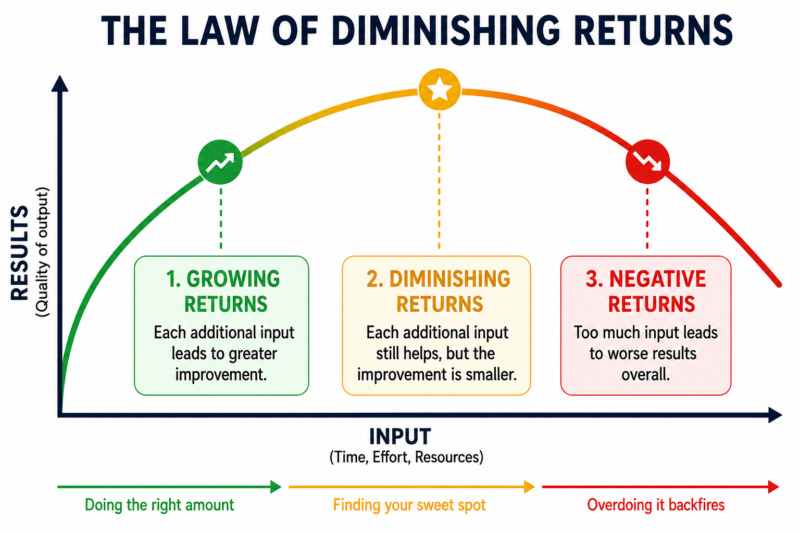
The graph below shows you how this works. The top star in the yellow section is the pivot point where diminishing returns shift downward, creating negative impacts.
Best Practice:
When you notice that you’re rereading the same paragraph, making careless mistakes, struggling to think clearly, or taking twice as long to accomplish half as much, pay attention. You’ve likely crossed the pivot point.
Take a break, stop for the day, or whatever you need to do to allow your brain and body to rest. And don’t resume until you’re back on the right side of the graph.
Do your hardest tasks at the optimal time of day for you when your brain works best.
Avoid procrastination that puts you in deadline purgatory so that you’re forced into working through diminishing returns.
Trick or Treat?
Being aware of the Law of Diminishing Returns is helpful, but it’s not quite enough. You have to be aware of its lure. It’s like “trick or treat!”
The treat is that when you are on the front side of the curve, you feel good! You’re getting a lot done, you’re in the groove, you’re seeing results. Naturally, you want to keep going.
It’s also the trick. Because that success you’re experiencing convinces you that doing more will produce even more. You don’t notice that you’ve crossed the pivot point because you’ve been working so well.
That’s the lure.
The goal is to know when enough is enough.
And that takes practice and self-awareness. The more you watch yourself, the easier it is to know when to step back.
A Good Way to Break It Up
There’s a psychological phenomenon called “regression in service of the ego.” An example would be taking a day off, reading novels, or binge-watching a favorite TV show while lounging on the couch.
Sometimes a little regression yields a fresh outlook and a burst of energy and productivity. I wrote more about why this works and how to use it here.
Try it!
That’s all for today.
Have a great two weeks!
All my best,
Barbara